New Petrol Price in Pakistan Rs. 377.71 Per Litre
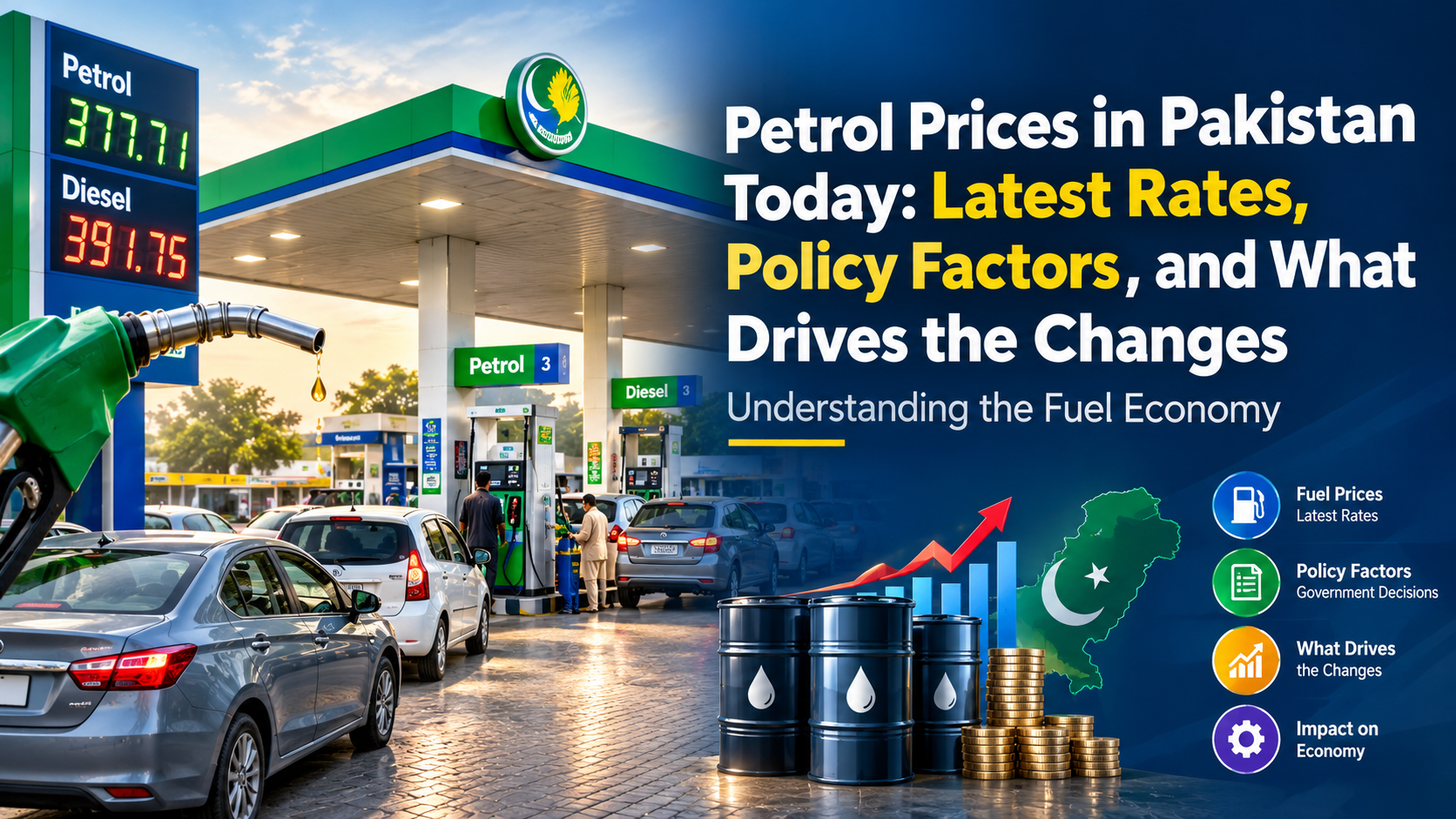
The government has revised fuel rates again, and the new petrol price in Pakistan is Rs. 377.71 per litre, effective Petrol has become cheaper by Rs. 1.60, while high-speed diesel has gone up by Rs. 1.64.
The change looks small, but it comes after one of the most volatile years for fuel prices in Pakistan’s history. In this article, we explain the latest rates, how prices got here, how much tax you pay and what you can do to save money.
For more headlines, visit our latest Pakistan news page.
Current Fuel Prices in Pakistan (23 October 2026)
| Product | Price per Litre | Change |
|---|---|---|
| Petrol (Premier Euro 5) | Rs. 377.71 | Down Rs. 1.60 |
| High-Speed Diesel (HSD) | Rs. 391.75 | Up Rs. 1.64 |
| Light Diesel Oil (LDO) | Rs. 267.46 | n/a |
| Kerosene (SKO) | Rs. 326.75 | n/a |
| JP-1 (jet fuel) | Rs. 352.41 | n/a |
According to Dawn, the Petroleum Division’s notification makes these prices applicable for Friday, 23 October. PSO’s published rates match these figures. You can track live updates on our daily petrol price page.
What Exactly Changed?
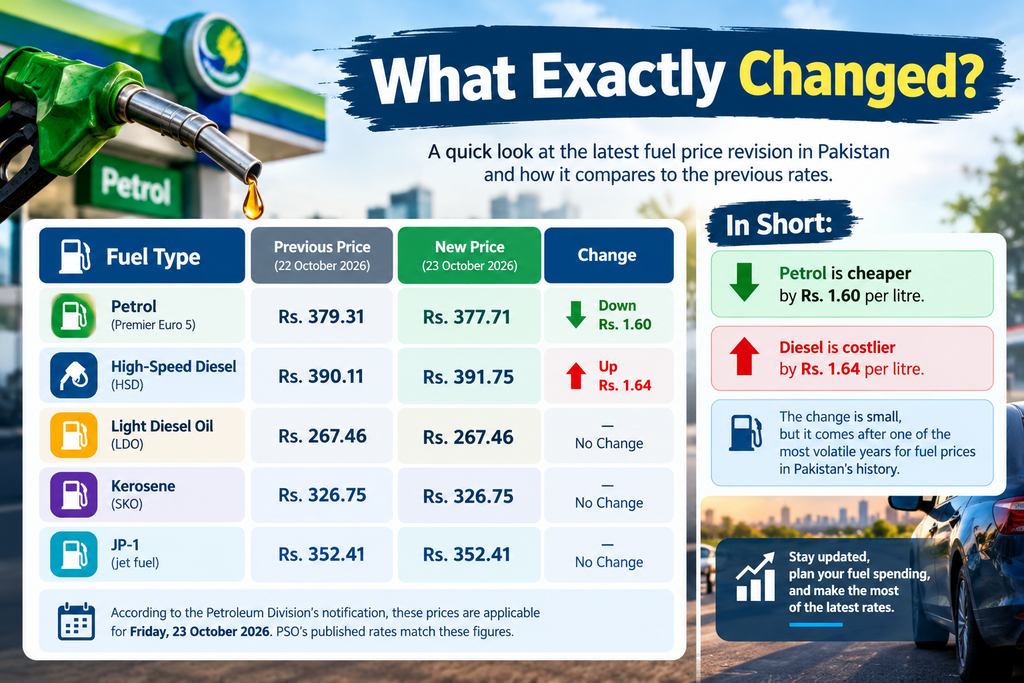
Before this revision, petrol was Rs. 379.31 per litre, so the new price is Rs. 1.60 lower. Diesel moved in the opposite direction, rising from Rs. 390.11 to Rs. 391.75. As a result, diesel is now about Rs. 14 per litre more expensive than petrol.
In everyday terms, the cut means:
- A 10-litre fill-up costs about Rs. 16 less.
- A 40-litre tank costs about Rs. 64 less.
- A commuter using 5 litres a day saves roughly Rs. 240 a month.
The relief is modest, but downward moves have been rare this year, so motorists will take it.
How Far Have Prices Come Since the Peak?
Today’s rates look calmer when compared with the highs of 2026. Dawn reports that fuel prices began climbing after the US-Iran war broke out on 28 February.
Petrol rose from around Rs. 266 in the first week of March to a peak of Rs. 458.41 on 3 April. Diesel climbed from about Rs. 281 to Rs. 520.35 on the same date.
Measured against those peaks:
- Petrol is now about Rs. 80.70 lower, a fall of roughly 18 percent.
- Diesel is now about Rs. 128.60 lower, a fall of roughly 25 percent.
However, both fuels are still far above their pre-war levels. Petrol costs around Rs. 112 more than it did in early March. So while the trend since April is downward, households are still paying much more than they were at the start of the year.
How Much Tax Is in Your Fuel Price?
A big part of what you pay at the pump goes to the government. Dawn notes that taxes and duties continue at Rs. 114 per litre on petrol and Rs. 100 per litre on diesel. That works out to roughly 30 percent of the petrol price and about 26 percent of the diesel price.
This is one reason why changes in global oil prices do not always lead to equally large changes at the pump. A fixed per-litre levy stays in place whether crude oil goes up or down. For a full explanation of every component, read our guide on what makes up Pakistan’s petrol price.
Why Do Prices Change Every Day?
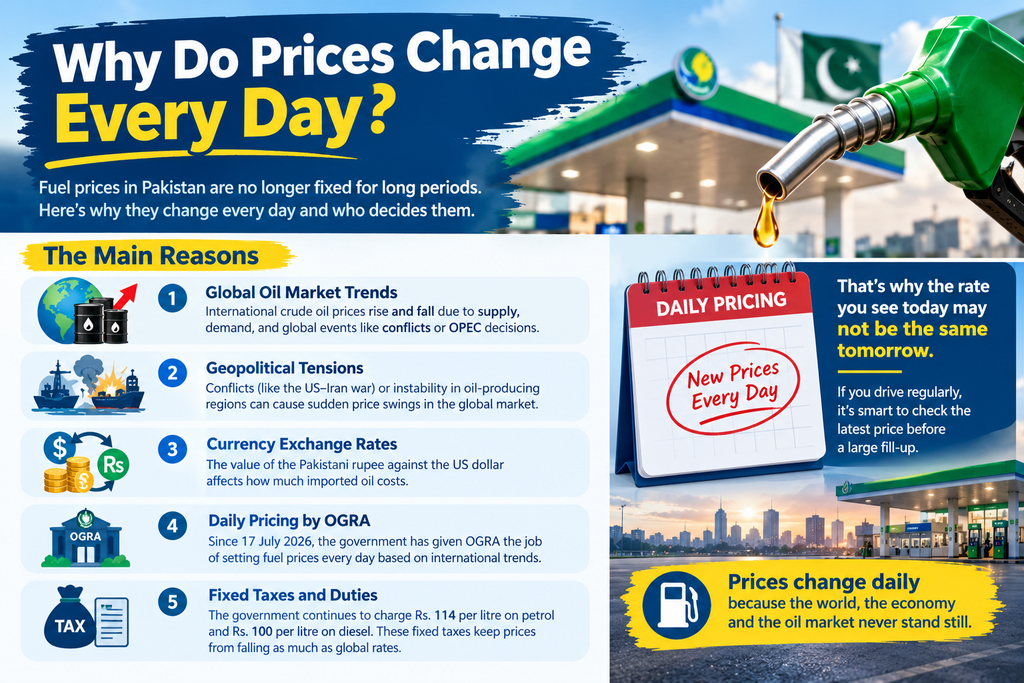
Pakistan’s pricing system has changed a lot this year. After the war began, the government started announcing weekly revisions in early March.
Then, on 17 July, Petroleum Minister Ali Pervaiz Malik announced that prices would be fixed daily, because international markets had become unstable following renewed hostilities between Iran and the US.
The cabinet and the prime minister gave the Oil and Gas Regulatory Authority (Ogra) the job of deciding prices every day based on global trends.
This means the rate you see today may not be the rate you see next week. If you drive regularly, it is smart to check the latest price before a large fill-up.
Who Is Affected Most by Petrol and Diesel Prices?
Petrol is mainly used in private cars, small vehicles, rickshaws and two-wheelers. This means petrol price changes hit the middle and lower-middle classes first. When petrol rises, the cost of going to work, school and the market rises with it.
Diesel works differently. It powers heavy transport, power plants and large generators, so its price affects almost everyone indirectly. When diesel gets costlier, trucking costs rise, and those costs slowly move into the price of vegetables, flour, cooking oil and other daily goods.
Farmers who use diesel for tractors and tube wells also feel the pressure. That is why the Rs. 1.64 diesel increase deserves attention even though it is small. To understand the wider effect, read our explainer on how petrol prices affect inflation in Pakistan.
Kerosene and LDO Rates
Kerosene (SKO) is priced at Rs. 326.75 per litre, and Light Diesel Oil (LDO) at Rs. 267.46 per litre. Kerosene is used mainly for heating and lighting, and demand usually rises as winter approaches. Even so, its volume is tiny compared with petrol and diesel.
Dawn reports that petrol and diesel together sell about 700,000 to 800,000 tonnes a month, while kerosene demand is only around 10,000 tonnes. This is why petrol and diesel decisions drive both government revenue and the wider economy.
Austerity Measures and Relief Schemes
The government has also tried to reduce fuel use and cushion the public from high prices:
- Austerity measures: Markets are required to close by 9 pm, and fuel allocations for official vehicles have been cut by 50 percent for three months.
- Relief scheme: On 13 September, Prime Minister Shehbaz Sharif announced a relief scheme for users of motorcycles, autos and vehicles up to 800cc.
- Targeted subsidies: In April, the government announced targeted relief measures to provide subsidised fuel.
If you own a small vehicle, check our guide to the PM relief scheme for motorcycles and small cars to see whether you qualify.
Simple Ways to Save Fuel
With prices still high, small habits can make a real difference:
- Keep your tyres properly inflated and your engine well maintained.
- Combine several errands into one trip.
- Avoid idling and sudden acceleration.
- Remove extra weight from your vehicle.
- Consider carpooling or public transport for daily commutes.
For more practical ideas, read our fuel-saving tips for car and bike owners. If you are planning to buy a vehicle, fuel efficiency matters as much as the sticker price, as our car buying guide for Pakistan explains.
What Can We Expect Next?
Because prices are now decided daily, future rates depend mainly on international oil markets and the situation in the Middle East.
If tensions ease, prices could keep falling gradually. If hostilities flare up again, rates could rise quickly. Taxes of Rs. 114 on petrol and Rs. 100 on diesel will also continue to shape the final price.
The sensible approach is to plan fuel spending with some margin and follow updates regularly.
Final Word
The new petrol price in Pakistan is Rs. 377.71 per litre, a small cut after a turbulent year in which prices peaked above Rs. 458.
Diesel has edged up to Rs. 391.75. With daily pricing in place, rates can change quickly, so keep checking our daily fuel rates and read our personal finance tips for Pakistani households to manage your budget better.